Free Notary Acknowledgement Document for the State of Kansas
The Kansas Notary Acknowledgement form plays a crucial role in the realm of legal documentation, serving as a vital tool for verifying the authenticity of signatures on various documents. This form is essential for individuals looking to ensure that their agreements, contracts, or other important papers hold up in legal contexts. It provides a structured way for a notary public to confirm that the person signing the document is indeed who they claim to be, and that they are doing so willingly and without any coercion. The form typically includes details such as the date of the acknowledgment, the name of the signer, and the notary's signature and seal. By utilizing this form, parties can enhance the credibility of their documents, making it easier to uphold their rights and obligations. Understanding the nuances of the Kansas Notary Acknowledgement form is essential for anyone involved in legal transactions, as it helps to navigate the complexities of notarization and ensures compliance with state regulations.
Document Sample
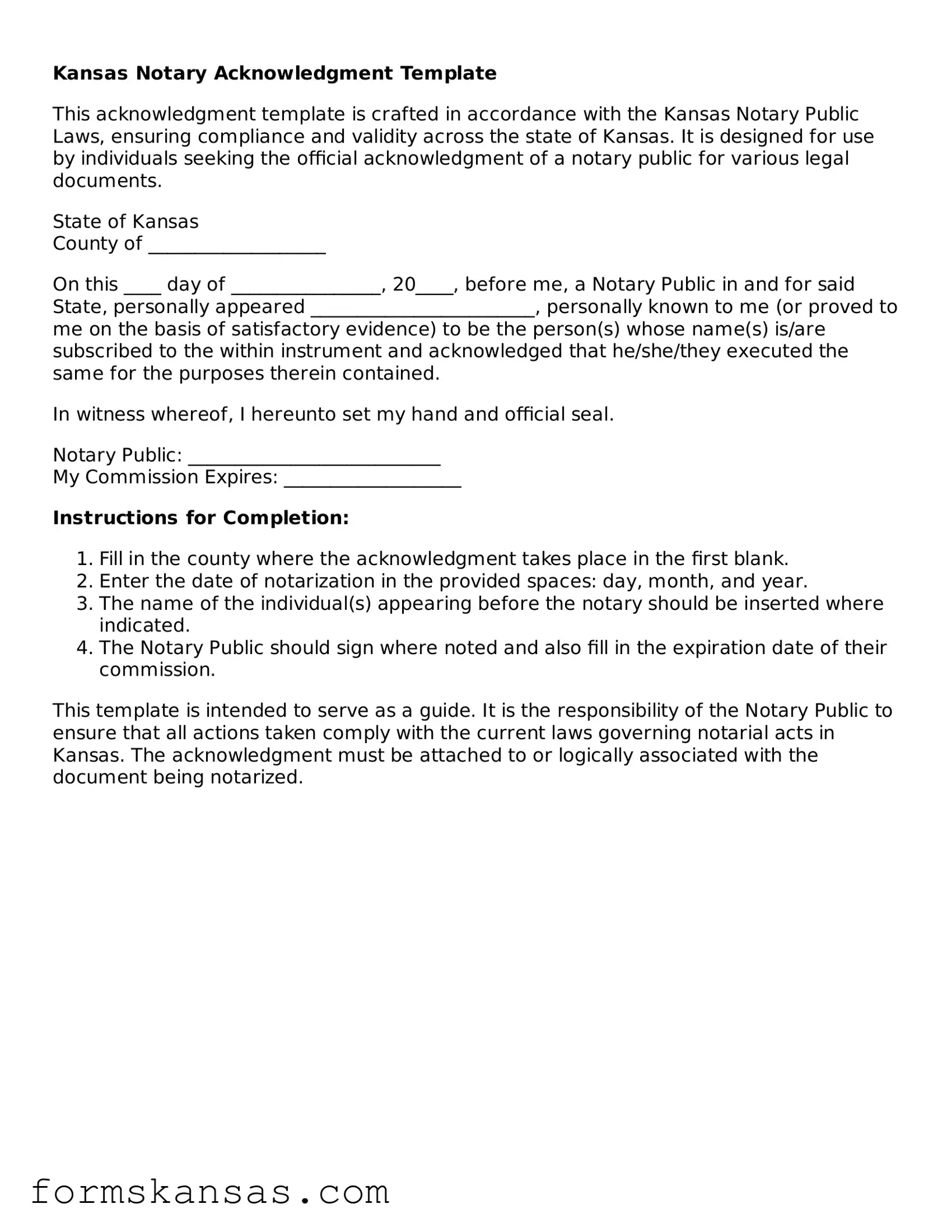
Kansas Notary Acknowledgment Template
This acknowledgment template is crafted in accordance with the Kansas Notary Public Laws, ensuring compliance and validity across the state of Kansas. It is designed for use by individuals seeking the official acknowledgment of a notary public for various legal documents.
State of Kansas
County of ___________________
On this ____ day of ________________, 20____, before me, a Notary Public in and for said State, personally appeared ________________________, personally known to me (or proved to me on the basis of satisfactory evidence) to be the person(s) whose name(s) is/are subscribed to the within instrument and acknowledged that he/she/they executed the same for the purposes therein contained.
In witness whereof, I hereunto set my hand and official seal.
Notary Public: ___________________________
My Commission Expires: ___________________
Instructions for Completion:
- Fill in the county where the acknowledgment takes place in the first blank.
- Enter the date of notarization in the provided spaces: day, month, and year.
- The name of the individual(s) appearing before the notary should be inserted where indicated.
- The Notary Public should sign where noted and also fill in the expiration date of their commission.
This template is intended to serve as a guide. It is the responsibility of the Notary Public to ensure that all actions taken comply with the current laws governing notarial acts in Kansas. The acknowledgment must be attached to or logically associated with the document being notarized.
Form Features
| Fact Name | Details |
|---|---|
| Purpose | The Kansas Notary Acknowledgment form is used to verify the identity of a signer and their willingness to sign a document. |
| Governing Law | This form is governed by the Kansas Statutes Annotated, specifically K.S.A. 53-501 et seq. |
| Signature Requirement | The signer must personally appear before the notary public to acknowledge their signature. |
| Notary's Role | The notary public must complete the form by filling out their details and affixing their seal after witnessing the signature. |
| Document Types | This acknowledgment can be used for various documents, including deeds, contracts, and powers of attorney. |
Other Popular Kansas Templates
How to Write a Bill of Sale for a Car in Kansas - It provides a basis for legal recourse in cases where the transaction terms are not met or the item is misrepresented.
Whats Dnr - Having a DNR in place can minimize the emotional and physical toll on patients and families during the final stages of life.
To protect your sensitive information, consider utilizing this important Non-disclosure Agreement form tailored for California businesses. By understanding its stipulations, you can ensure confidentiality in your professional dealings. For detailed information, refer to this valuable Non-disclosure Agreement document.
How to Get Out of Non Compete - A protective legal document that companies use to prevent the possibility of competition or trade secret leakage by former employees.